Parenting without punishment: what actually works instead
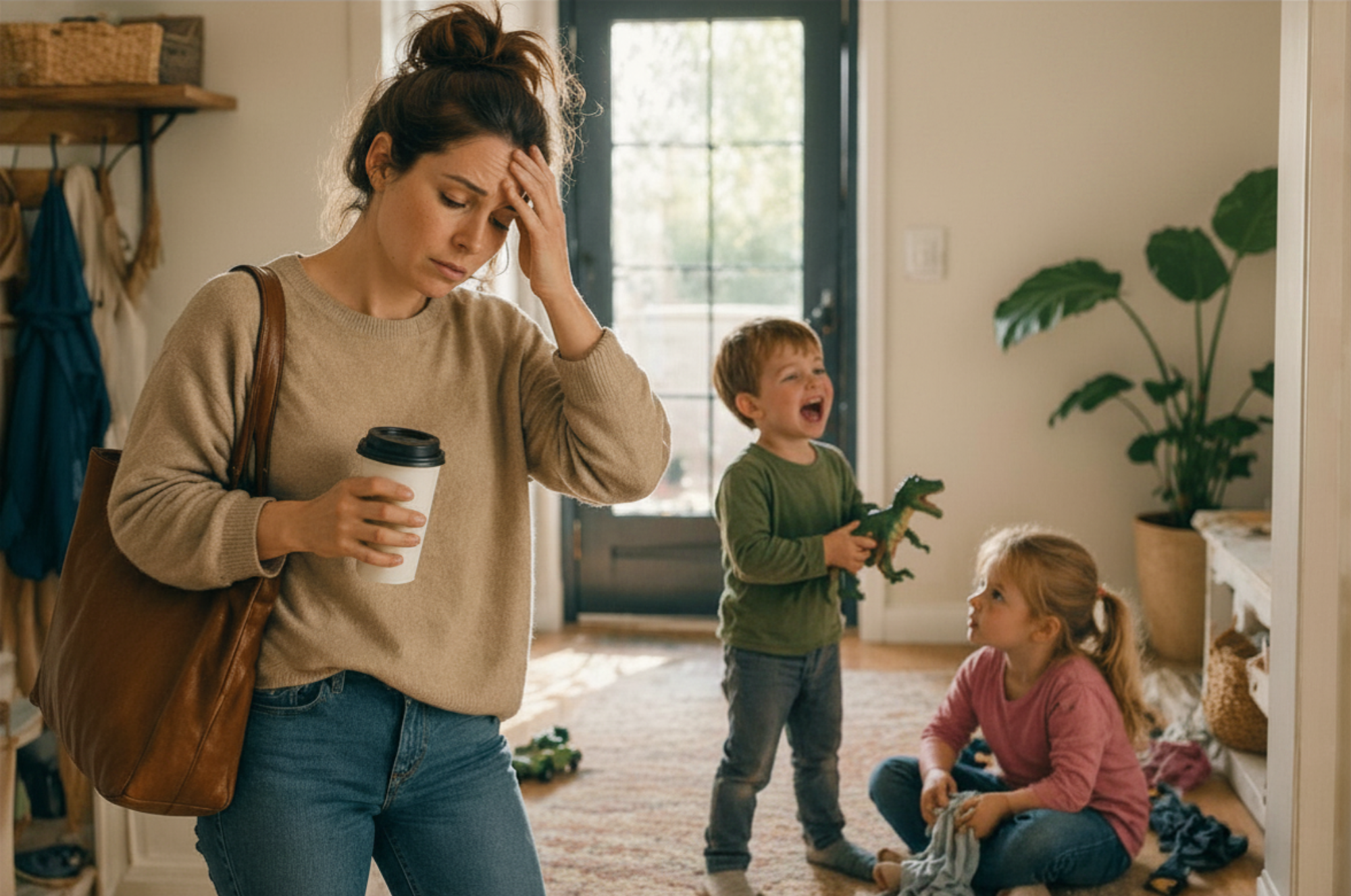
A familiar morning moment where time pressure builds while children are absorbed in their own world, making cooperation harder to achieve.
You’ve asked three times.
Nothing.
You try again, a bit firmer this time. Still nothing.
You feel it building. The tension. The urgency. You’re already late.
“Put your shoes on.”
Ignored.
And then it tips.
“Right, that’s it. No screen time for you all day.”
There it is.
It works. Sort of. Just enough to get you out of the door.
And ten minutes later, you’re in the car, replaying it on the way to school.
You sense that familiar knot in your stomach.
Wondering why it always seems to end up here.
Why you can’t just stay calm.
Why you keep saying things you don’t actually want to say.
If that loop feels familiar, you’re not broken. You’re not failing.
You’re a parent who cares deeply, running on empty, falling back on the only tools you were ever given.
Because this is what most of us were taught.
This is what we saw growing up.
This is what society still quietly expects.
This is what gets called “good discipline”.
Raise your voice.
Take something away.
Make the consequence bigger next time.
It makes sense that you go there.
But here’s the part that often gets missed.
In that moment in the hallway… when you said “no screen time all day”… what actually happened?
Your child moved.
Maybe faster than before.
Maybe with a sigh.
Maybe with a slammed door.
But not because they understood.
Not because they agreed.
Not because they suddenly wanted to cooperate.
They moved because the consequence got bigger.
And while that works in the moment, it doesn’t build what you actually want.
It doesn’t teach real cooperation, support emotional regulation, or strengthen your relationship with your child. And that’s not a personal failing. It reflects a deeper mismatch between what many of us have been taught and what actually helps children learn, regulate, and work with us.
And this is where things start to make more sense.
What is punishment, exactly?
In psychology, punishment is any response to an unwanted behaviour that is designed to be unpleasant, either by adding something aversive (a raised voice, a smack) or removing something valued (screen time, a favourite toy, your attention).
It’s rooted in behaviourism, the idea that we can shape behaviour through reward and consequence. The problem is that this model was developed through experiments on animals, mostly rats and pigeons. And humans are not pigeons. We have an inner world that this model doesn’t account for.
It doesn’t take into account a child’s nervous system, their unmet needs, or the emotions driving the behaviour in the first place.
The most common forms of punishment (including some you might not expect)
In everyday life, punishment doesn’t always look the way we expect it to.
Some forms are obvious:
Physical punishment, such as smacking or slapping
Shouting, scolding, shaming
Removing privileges, such as screens, activities, or toys
Grounding or social restriction
Others are more subtle, and often more confusing for children:
Silent treatment or withdrawal of warmth
Time-outs used as isolation
Time-outs are actually worth pausing on. They were originally introduced as a move away from physical punishment, which is definitely a step forward.
But when a child is sent away alone as a consequence, they can experience it as a withdrawal of love and connection.
And instead of learning to regulate, they often learn to shut down.
Ask yourself this:
When you remove a child from a situation, what’s the intention?
If your aim is to help them calm down and regain emotional regulation, then yes, absolutely do that. But how you do it matters.
Frame it as a moment to calm down, not a punishment.
Keep it brief. Stay calm yourself. And make sure there is reconnection afterwards.
Where possible, stay nearby. If your child needs you, be with them. Guide them through what they’re feeling.
This is what we call co-regulation.
Your calm, regulated presence helps their nervous system settle.
Sometimes this approach is referred to as a “time-in” rather than a time-out, because the focus shifts from isolation to support.
And it works very differently in the brain.
I’ll come back to this in more detail later, because it sits at the heart of what actually helps children learn and cooperate.
Why punishment doesn’t actually work
At first glance, punishment can seem effective. It gets a response and moves things along. But if you look a little more closely, a different pattern starts to emerge.
Punishment-based parenting closely resembles what research describes as authoritarian parenting, where there is high control and high expectation, but low warmth and emotional support, and a strong focus on obedience.
Consistently, this approach is linked to less favourable outcomes for children.
Children raised in these environments are more likely to experience anxiety, lower self-esteem, and greater emotional vulnerability. They often struggle with independence and may rely heavily on external approval to feel secure.
Over time, this also shows up in behaviour, with increased aggression, more conflict in relationships, and lower social competence.
This is not accidental. It reflects what punishment is actually teaching.
The first thing punishment does is trigger fear. And when a child feels afraid, their brain shifts into survival mode. Instead of reflecting on what they did or how it affected someone else, they become focused on avoiding the consequence next time.
In that state, genuine learning becomes very difficult. Remorse depends on empathy, but fear interferes with empathy, making it hard for both to exist together.
As a result, children are less likely to internalise responsibility. Instead, they may become more focused on avoiding detection, hiding things more carefully, bending the truth, or pushing back against control.
Punishment can also create anger. When children feel controlled or treated unfairly, that emotional response does not simply disappear. It may turn inward as shame or self-doubt, or outward as defiance, aggression, or conflict.
At the same time, punishment provides a powerful model.
It teaches that when something goes wrong, the person with more power uses force to resolve it. Not connection or problem-solving, but control.
Children learn from that. They carry it into their relationships with siblings, peers, and eventually into adulthood.
Over time, punishment also becomes less effective.
What works with a younger child often stops working as they grow, which means the consequences need to become bigger or harsher to have the same effect. And the more this pattern is relied upon, the less genuine influence a parent tends to have.
Because influence grows from relationship, not from control.
And punishment, often quietly and unintentionally, erodes that relationship. It teaches children that when they get things wrong, they risk losing connection, warmth, or understanding.
Children adapt to that. They may begin to share less, to hold things back, or to protect themselves rather than turn towards their parent.
At the same time, their focus shifts away from what actually matters. Instead of reflecting on their behaviour or its impact, they become preoccupied with the consequence, how unfair it feels, and how to avoid it next time.
Gradually, the question guiding their behaviour changes. Rather than asking what kind of person they want to be, they are more likely to focus on what is expected of them and what will happen if they do not meet those expectations.
This shift is subtle, but significant.
Because real moral development grows from connection, reflection, and feeling safe enough to care.
And punishment, by its nature, tends to move children away from those conditions.
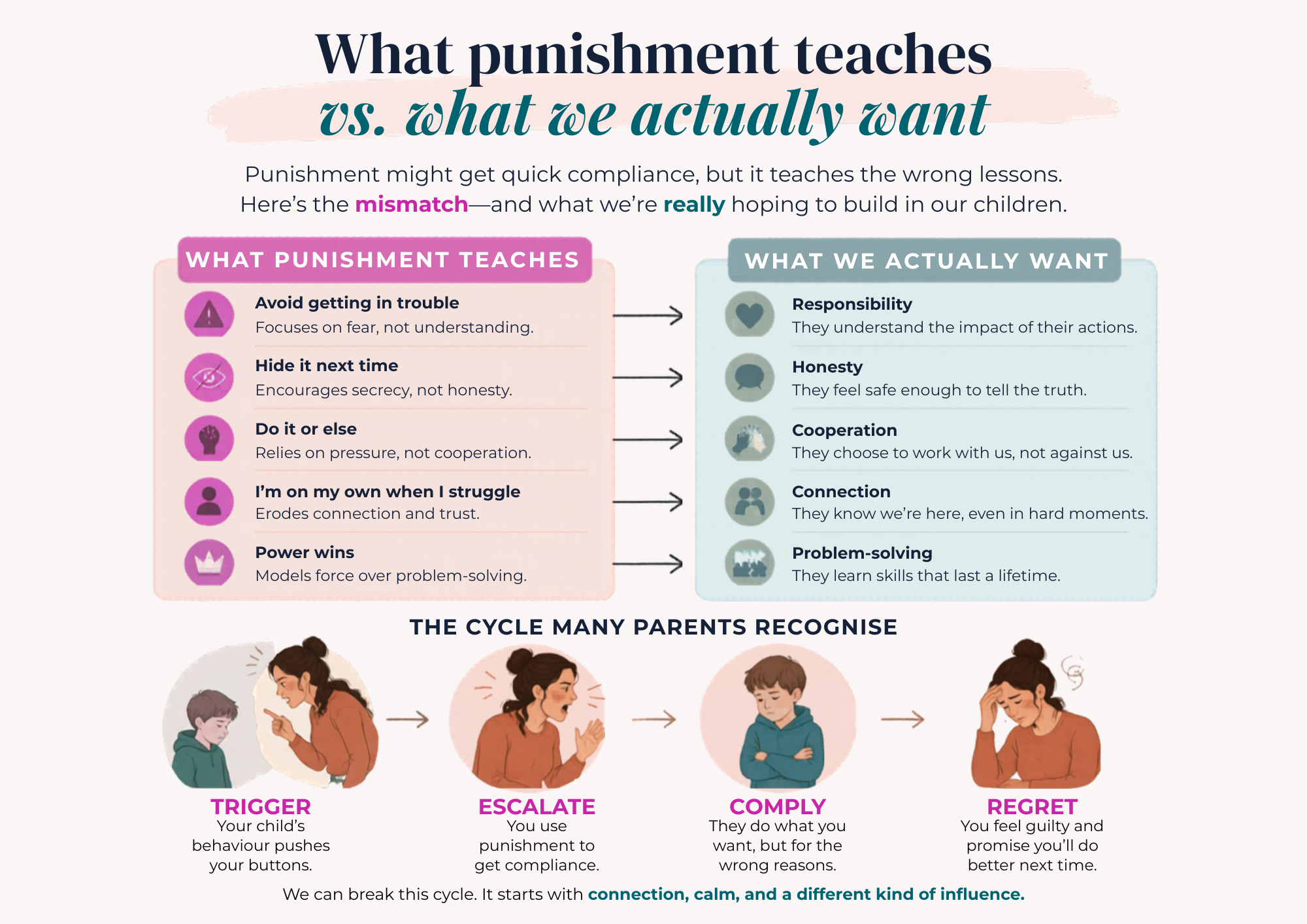
Punishment can change behaviour in the moment, but it often teaches children to avoid consequences rather than understand their actions. This visual shows the difference between what punishment reinforces and the values most parents want to nurture over time.
What’s actually going on when a child “misbehaves”
Behaviour is communication, always.
When a child hits, refuses, ignores, or melts down, there is almost always something underneath the behaviour. It might be hunger, exhaustion, emotional overwhelm, a need for connection, or simply a nervous system that has been stretched beyond what it can manage in that moment.
When we respond with punishment, we are addressing what we can see on the surface, but we are not touching what is driving the behaviour in the first place.
And because of that, the behaviour tends to return, often more intensely, because the underlying need has not been met which is why the same patterns tend to repeat, even when the consequences get stronger.
This is where many parents begin to feel stuck. You try the consequence, the warning, the explanation, the firmness, and yet nothing seems to hold for long.
That is not a reflection of a lack of effort or consistency.
It is a mismatch between what the child is communicating through their behaviour and what the strategy is designed to address.
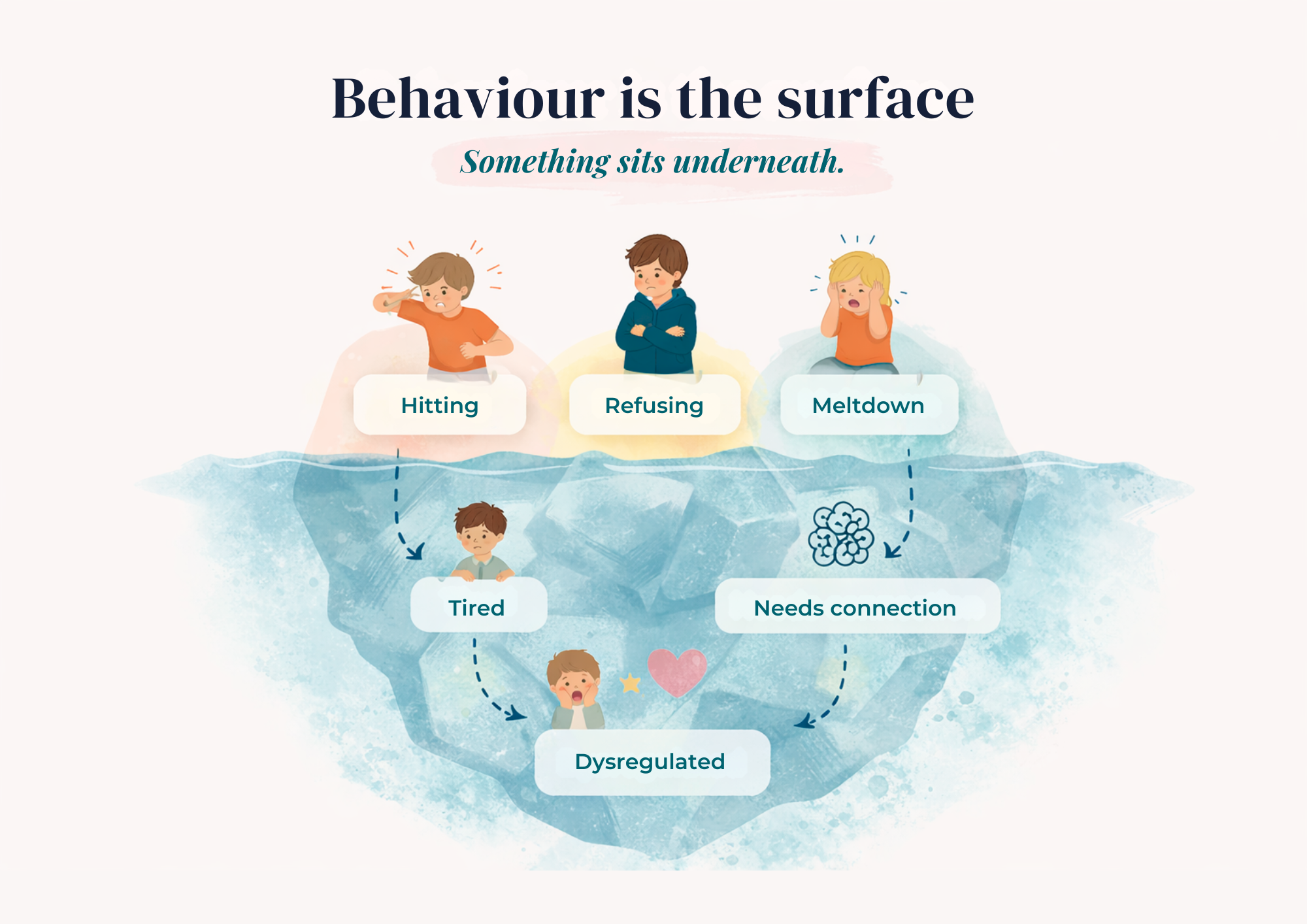
What we see as “misbehaviour” is often just the surface. Underneath, children may be tired, overwhelmed, or struggling to regulate their emotions, which is why addressing the root cause is more effective than reacting to the behaviour alone.
Okay… so if punishment doesn’t work, how do I get my child to listen?
This is the real question.
Because you don’t just want understanding. You want cooperation. You want things to actually work in real life, when you’re late, tired, and out of bandwidth.
And this is where the approach needs to change.
Children don’t learn to cooperate through fear. They learn to cooperate when they feel safe, connected, and guided by a calm, confident adult.
This isn’t about being permissive. Structure still matters deeply. But it’s held in a different way, one that combines clear limits with warmth and support.
In practice, this often looks like:
1. Start with connection, not control
Before a child can follow your lead, they need to feel connected to you.
That can be as simple as moving closer, saying their name, making eye contact, or gently getting their attention before you ask anything of them. When a child is absorbed in play or overwhelmed, they often aren’t ignoring you on purpose. They simply aren’t in a place where they can take in what you’re saying.
Connection brings them back to you. And from there, cooperation becomes much more possible.
2. Be clear and lead with confidence
Children need us to take the lead. Not by controlling them, but by being clear about what matters.
Long explanations tend to get lost, especially in the moment. What works better is calm, simple, confident language:
“It’s time to go. Shoes on.”
Not harsh. Not threatening. Just clear.
Children feel safer, and are more likely to cooperate, when the adult in front of them feels steady and certain.
3. Follow through by supporting, not threatening
If a limit is set, it needs to be followed through. But that doesn’t mean escalating consequences.
It means stepping in and helping your child do what they’re struggling to do.
“If you’re not putting your shoes on, I’m going to help you.”
And then you do. Calmly. Without anger.
Sometimes children don’t need a bigger consequence. They need more support. In parenting terms, this is often called scaffolding, closing the gap between what we expect and what they can manage in that moment.
4. Work with the nervous system, not against it
A child who is overwhelmed cannot cooperate.
If your child is tired, frustrated, or dysregulated, pushing harder rarely works. What helps is bringing their nervous system back to a place where they can think, listen, and respond.
That might mean pausing, offering connection, or simply staying calm enough for them to settle.
Only then does problem-solving become possible.
5. Build cooperation outside the hard moments
Cooperation is not created in the moment of conflict. It’s built over time.
Children are far more likely to listen and work with us when the relationship feels strong. Small, everyday moments of connection, play, laughter, and shared attention are what build that foundation.
It’s also what gives you influence in the long run. When children feel close to you, they are much more likely to care about what you say and follow your lead.
6. Look for ways to work together, not against each other
Sometimes resistance isn’t about defiance, but about a clash of agendas. Your child wants one thing, and you want another.
Instead of pushing harder, it can help to look for small ways to bring those two agendas closer together. That might mean offering a choice, turning the moment into something playful, or involving your child in solving the problem.
When children feel some sense of control or involvement, they are far more likely to cooperate willingly.
This is what the research consistently shows.
The most effective parenting style isn’t the strictest, and it isn’t the most lenient. It’s the one that combines warmth with clear structure.
Children raised in this kind of environment tend to develop stronger emotional regulation, healthier relationships, higher self-esteem, and more genuine, lasting cooperation over time.
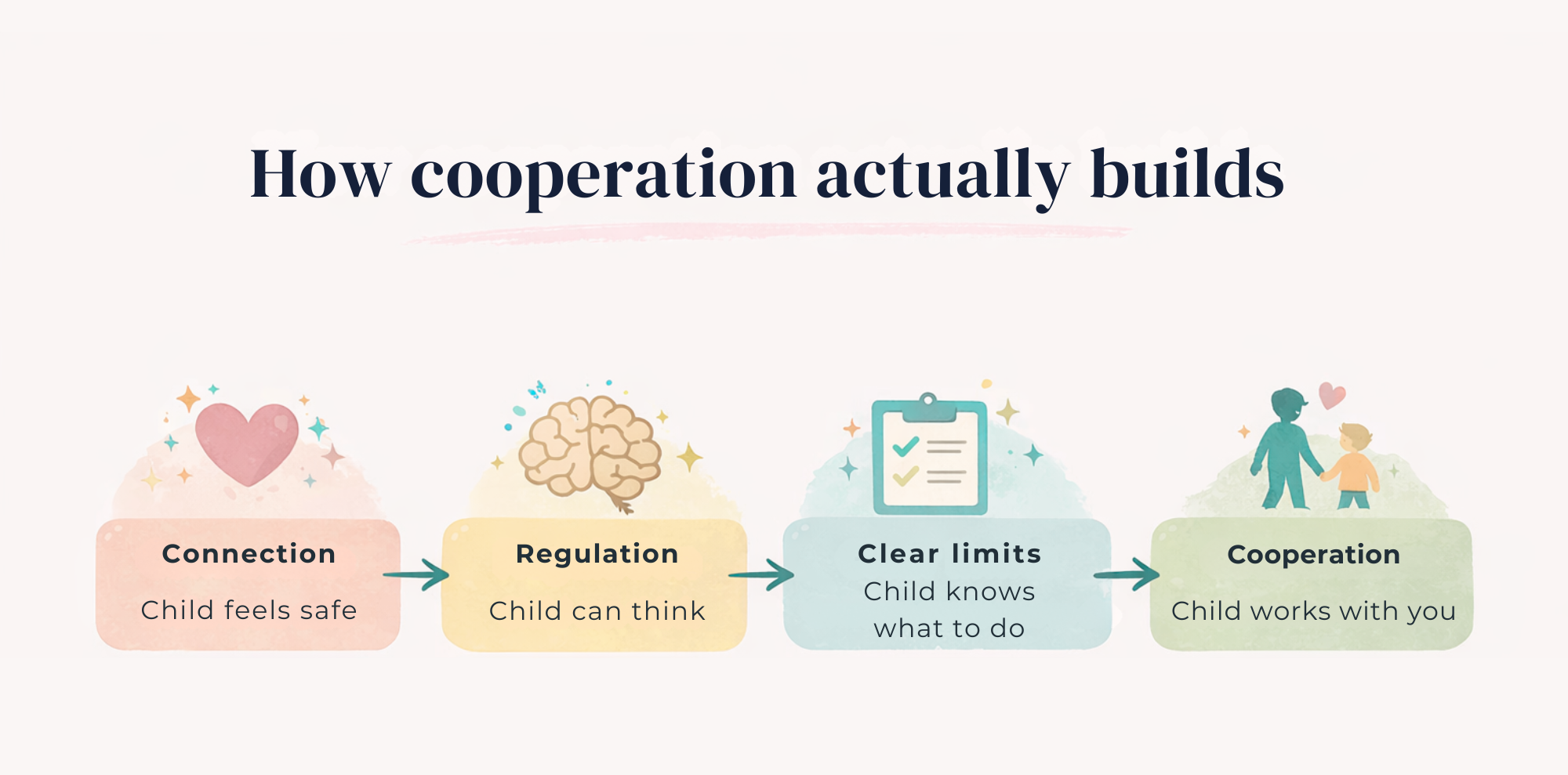
Children are far more likely to cooperate when they feel safe, regulated, and clearly guided. This visual shows the sequence that supports cooperation, rather than trying to force it in the moment.
The guilt cycle, and how to interrupt it
And then there’s the part most parents recognise immediately: the guilt cycle.
Most parents reading this already know much of what’s written here.
The knowledge isn’t the problem.
The problem is the moment when you’re late, your child isn’t listening, and your nervous system is already stretched, standing in the hallway, trying to get out of the door.
That’s where the cycle happens.
Snap. Regret. “I’ll do better tomorrow.” Repeat.
This isn’t about willpower.
It’s about capacity.
If you’re constantly running on empty, you will default to control. Not because you want to, but because your system is overwhelmed.
The shift isn’t about becoming endlessly calm.
It’s about understanding what’s happening in you, what your child’s behaviour is triggering, and learning how to respond rather than react.
That’s a skill. And it can be built.
And in those moments, the goal isn’t perfection.
It’s something much simpler.
To pause, even briefly.
To reconnect, before you direct.
To hold the limit, without adding fear.
And when it doesn’t go the way you hoped, to come back and repair.
You’re not a failing parent who needs fixing.
You’re a good parent under strain.
And when you start working with that, instead of against it, things begin to shift.
Even in those rushed moments in the hallway.
Even on those drives to school.